
Federal Agency: From Bureaucratic to Top Performing
We worked with the Director of a large, complex, technologically advanced federal agency. Its mission was critical, but the organization had become arrogant, bulky, and unresponsive. Policies, procedures, products, services, and projects kept multiplying—creating layers of bureaucracy.
The agency had too many departments, each operating as a rigid silo. Cross‑department interaction was difficult. The hierarchy was steep and inflexible. Leadership relied on command‑and‑control, and employees were disengaged. When serious problems surfaced, management often retreated behind closed doors, threw money at the issue, and announced new changes that rarely achieved their objectives.

We introduced and led several agency‑wide improvement initiatives that boosted performance and streamlined costs by hundreds of millions of dollars. The project successes were exciting, but it was clear deeper change was needed. We proposed reinventing the entire agency. The Director not only agreed—he fully committed.
Select the Right Transformation Team Members
We worked closely with the Director to identify the next generation of key leaders. These carefully selected individuals were assigned full-time to one of three transformation teams organized around the agency’s core missions.
Initial Assessment
The teams began by meeting with stakeholders, customers, and partners to gather candid feedback. The assessments were sobering. However, the new environment created enough trust and psychological safety for people to speak openly about the need for change—something that had rarely occurred under the previous bureaucratic culture.
Each team prepared a compelling “case for change” report. The message was unmistakable: the agency needed to fundamentally change. The Director then led a broad communication effort to openly share these findings with stakeholders, partners, customers, and employees.
The Critical Role of Engagement
A key driver of this transformation was the level of engagement created across the agency. Employees, partners, and stakeholders were not passive recipients of change—they were active contributors. This engagement surfaced operational realities leaders could not see from the top, built trust in the process, and created the ownership needed to drive bold changes across missions, processes, technologies, and culture. Engagement became the engine that turned the transformation from a plan into a shared commitment.
THE TRANSFORMATION PROCESS
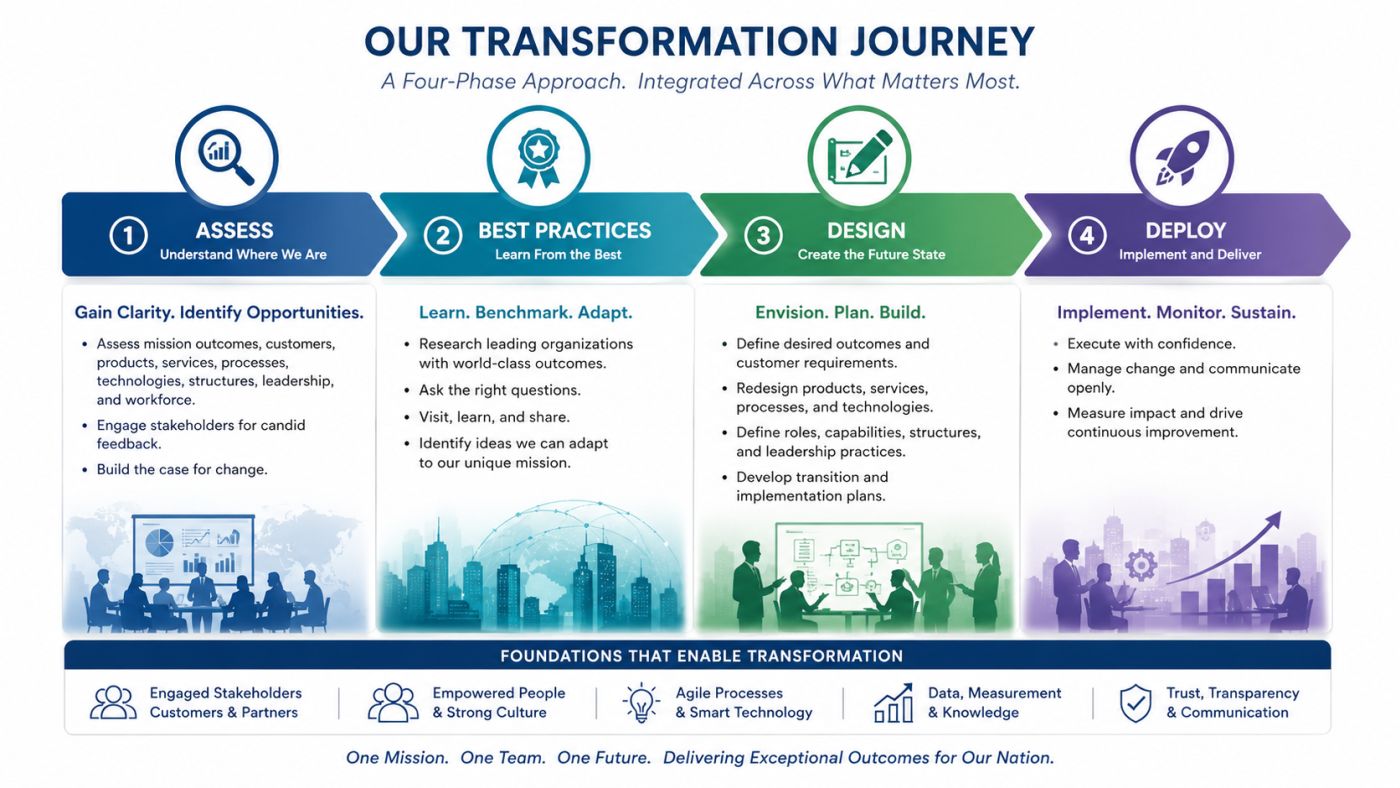
We guided the leadership teams through a four-phase transformation process:
Assess
Using a structured set of assessment tools, the teams evaluated mission outcomes, customers, products, services, processes, technologies, organizational structures, leadership practices, and workforce capabilities.
It quickly became clear that incremental improvement would not be enough. A comprehensive transformation was necessary. The agency was not agile, aligned, or prepared to meet the rapidly evolving demands of the future.
Best Practices
Benchmarking became one of the most important parts of the transformation effort. Learning from world-class organizations expanded thinking, challenged assumptions, and accelerated innovation.
At first, many believed the agency was too unique to compare with other organizations. Eventually, however, we developed a more useful perspective. Instead of looking for identical organizations, we identified companies that performed similar functions or achieved comparable outcomes in at least one important area.
We asked questions such as:
- Who does something exceptionally well that relates to our mission?
- What makes their outcomes world-class?
- What can we adapt to our own environment and culture?
- Which ideas would create meaningful value for our organization?
The teams visited leading organizations with a clear purpose: to learn. We also openly shared our own successes and challenges. Every visit generated insight we could apply to our own mission and culture. Over time, we realized we were not as uniquely different as we had assumed—a realization that opened the door to far greater innovation and learning.
Innovate and Design
Because the agency operated at the forefront of highly advanced and mission-critical capabilities, simply catching up was not enough. The organization needed to stay years ahead in critical mission areas.
Teams participated in structured innovation exercises to identify breakthrough opportunities and future-focused capabilities the agency needed to develop.
The teams involved employees throughout the organization in designing, prototyping, and piloting new solutions. During this phase, they:
Clearly defined desired outcomes
Identified stakeholder and customer requirements
Redesigned products and services
Developed new processes, technologies, measurements, and knowledge-management systems
Defined needed roles, capabilities, leadership practices, and organizational structures
Created transition and implementation plans
Deploy
Leaders and employees moved forward with confidence to implement the new solutions.
Leading Change
Leading change effectively was a major priority throughout the transformation effort. Significant effort was devoted to keeping stakeholders, customers, leaders, and employees informed, engaged, and involved throughout the process.
This occurred through town halls, presentations, staff meetings, focus groups, interviews, internal websites, memoranda, and one-on-one discussions.
The agency had an exceptionally talented workforce with highly specialized and mission-critical skills. Years had been invested in developing these capabilities, and leaders understood the importance of treating employees with honesty, respect, and transparency throughout the transition.
We also sought guidance from senior executives who had successfully led major corporate transformations. Their advice was consistent: communicate openly, clearly, and early. Help people understand what is changing, why it matters, and how it may affect them.
Results
The transformation effort placed stakeholders, partners, and customers at the center of every major decision. Teams spent significant time deeply understanding their needs and expectations. Based on those insights, products and services were redesigned and tailored to better meet mission demands.
Agility, flexibility, and mobility emerged as recurring priorities. Processes, technologies, organizational structures, leadership practices, and workforce roles were redesigned to support those objectives.
The disciplined planning, broad engagement, and coordinated execution produced significant results. Mission outcomes improved substantially, costs were reduced, and the culture strengthened considerably. The agency became fundamentally different from top to bottom.
As a result of these successes, the agency’s mission expanded rapidly. The Director was later promoted to a cabinet-level position and led the integration and modernization of multiple departments and agencies.